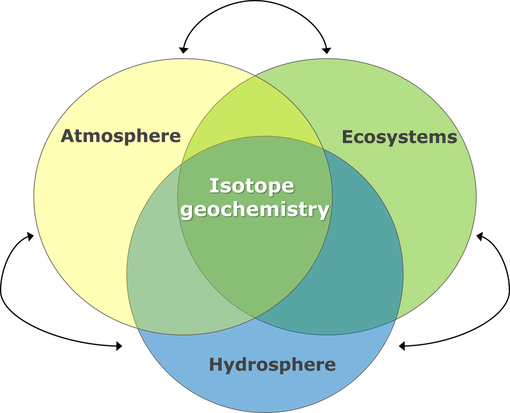
We use natural abundance stable isotopes to explore ecosystem change.
In the Elliott Lab at the University of Pittsburgh, we uncover chemical clues in the environment to understand how ecosystems function and respond to environmental changes. These clues are part of elemental cycles essential to our world, including rivers, streams, plants, forests, food webs, and the atmosphere. We study how factors like nutrient pollution, extreme events, invasive species, and built infrastructure impact the cycling of elements in watersheds with direct impacts to water quality, ecosystem health, and function. Our work spans the watershed ecosystems throughout western Pennsylvania and beyond, from mountainous headwater systems to meandering river floodplains and urban streams in Pittsburgh.
We utilize stable isotopes to track elements through water, soils, plants, and the atmosphere and to help us understand ecosystem change. Our research focuses on the biogeochemistry of both aquatic and terrestrial ecosystems, with a particular interest in how feedback mechanisms influence these systems. We are home of the Pitt Isotope Tracers Lab where we house three continuous flow isotope ratio mass spectrometer systems capable of measuring carbon, nitrogen, oxygen, and sulfur isotopes in inorganic and organic matter.